HENDRIK WITBOOI
FOUNDATION
A JOINT INITIATIVE OF
KAPTAIN HENDRIK WITBOOI DESCENDANTS
AND WITBOOI ROYAL HOUSE

Promoting his Legacy

Preserving his artifacts

Improving Socio-economic

Promoting Education

Promoting youth entrepreneurship
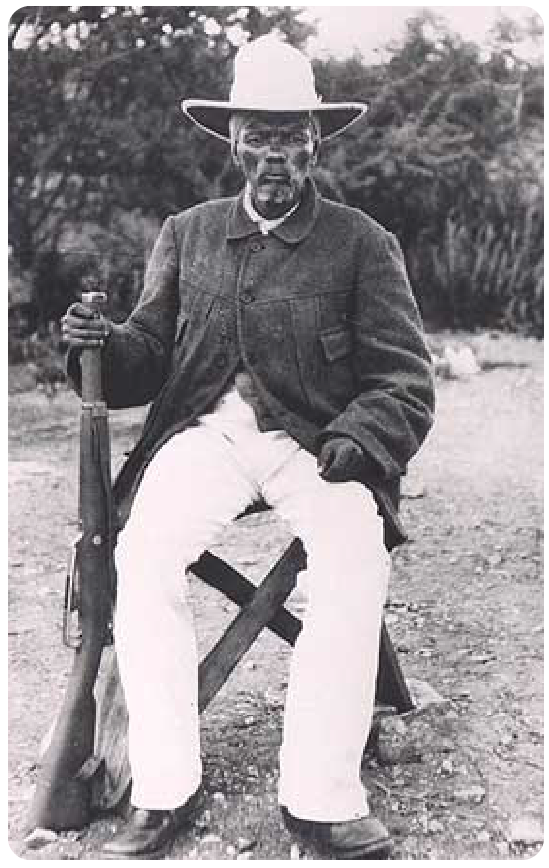
KAPTAIN HENDRIK WITBOOI
c.1830 – 29 October 1905
Chief of the /Khowese (|Khowesin) Nama People · National Hero of Namibia
Kaptein Hendrik Witbooi was a chief of the /Khowese (|Khowesin) people, one of the principal clans of the Nama nation in what is today Namibia. A man of profound courage, deep faith, and remarkable intellectual discipline, he stands as one of the most significant figures in southern African resistance history and is officially recognised as a National Hero of Namibia.
A LIFE SHAPED BY HERITAGE AND EDUCATION
Born around 1830 at Pella in the Northern Cape Colony, Witbooi came from a lineage of leaders: his grandfather, Gaob David Witbooi, led the /Khowese Nama northward across the Orange River into Namaland, and his father, Gaob Moses Witbooi, served as chief before him. Hendrik received a Lutheran missionary education and was well-versed in multiple languages, including his native Khoekhoegowab. He worked as a teacher in Keetmanshoop and Maltahöhe.
He became chief of the /Khowese in 1888 following a period of internal struggle, after which he united other Nama groups under his leadership. By 1890, he was recognised across the region as a paramount authority of the Nama people.
RESISTANCE, SOVEREIGNTY, AND THE PEN AS A WEAPON
Witbooi understood early that German colonialism posed an existential threat not just to land, but to identity, dignity, and self-determination. When German colonial officer Kurt von Francois offered the Nama “autonomy under German protection,” Witbooi rejected it outright, articulating a principle that remains the foundation of his legacy:
“We did not give our land away, and what has not been given by the owner, cannot be taken by another person.”
— Kaptein Hendrik Witbooi, in correspondence with German colonial authorities
After a surprise German military attack on his settlement at Hoornkrans in April 1893, which killed mainly women and children and destroyed their homes, Witbooi engaged the Germans in guerrilla warfare before being forced into a conditional peace treaty in 1894. He complied on paper. He never surrendered in principle.
What makes Witbooi distinctive among resistance leaders is that he fought with both a rifle and a pen. His diaries, letters, and meeting records, known as the Witbooi Papers, constitute one of the most extraordinary bodies of indigenous African correspondence from the colonial era. In 2005, UNESCO inscribed the archive in its Memory of the World International Register, recognising these journals as documentary heritage of global importance.
A FINAL STAND
When the Herero and Nama uprising erupted in 1904, Witbooi, already in his mid-seventies, tore up the peace treaty and led his people back into armed resistance against German colonial rule in October of that year, rallying his people with the conviction that God had guided them to fight for their freedom.
He was killed in action on 29 October 1905, near Vaalgras. His final words, spoken as he lay wounded on the battlefield, have echoed through generations:
“It is enough. The children should now have rest.”
— Kaptein Hendrik Witbooi, 29 October 1905
LEGACY
Kaptein Witbooi is one of nine National Heroes of Namibia honoured at the country’s Heroes’ Acre near Windhoek, and his portrait appears on the N$50, N$100, and N$200 Namibian banknotes. At the inauguration of Heroes’ Acre, founding President Sam Nujoma declared that Witbooi was the first African leader who took up arms against German imperialism in defence of Namibian land and territorial integrity, and that his revolutionary spirit and visionary memory deserved the nation’s honour and respect.
His legacy is not a relic. It is a living mandate: that sovereignty cannot be gifted by those who stole it, that dignity is not negotiated away, and that the children he spoke of in his final breath are still owed the rest he fought to secure.
The Hendrik Witbooi Foundation carries that mandate forward.
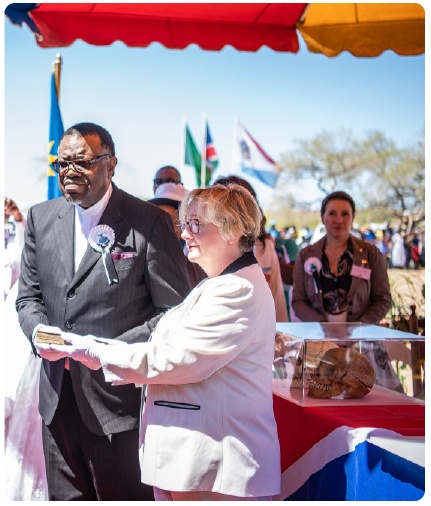
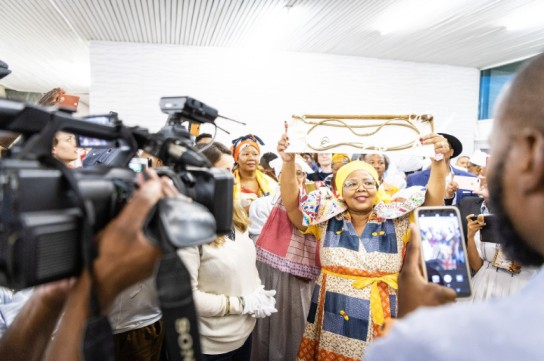
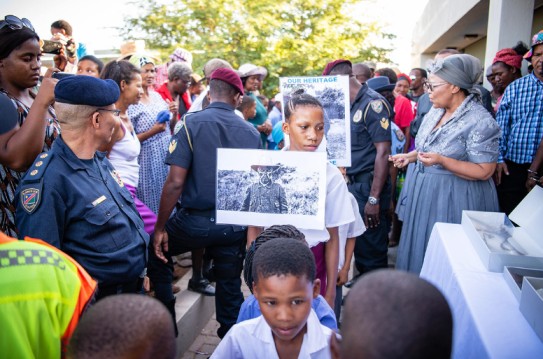
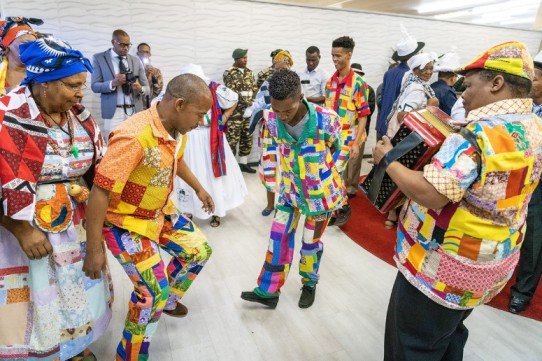
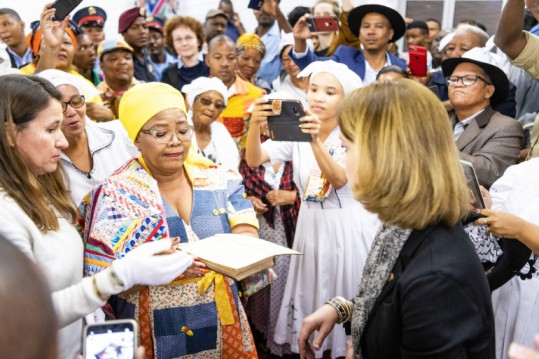
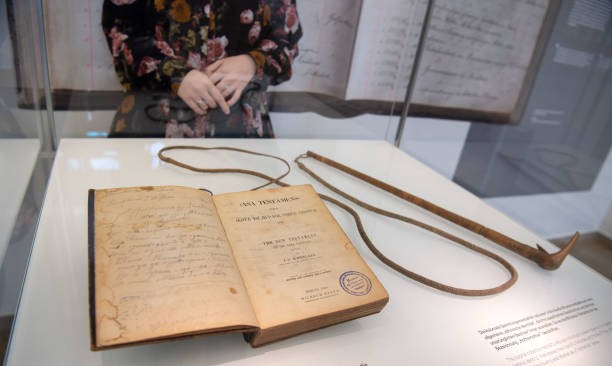
The return of Kaptain Hendrik Witbooi’s Artifacts from Germany
The Hendrik Witbooi foundation was established and registered in the governing laws of Namibia in 20008.The Witbooi Hendrik foundation is a joint initiative of Katein Hendrik Witbooi descendants and Witbooi Royal House focused on Promoting the legacy and ideals of our Great-Grandfather Kaptain Hendrik Witbooi. In this regard, it is anchored on 5 principles:
- To promote his legacy,
- Preserve his artifacts,
- Improve socio-economic conditions of the most vulnerable,
- Promote education, and
- Promote youth entrepreneurship.
IN THE ARCHIEVES
The return of Kaptain Hendrik Witbooi’s Artifacts from Germany